
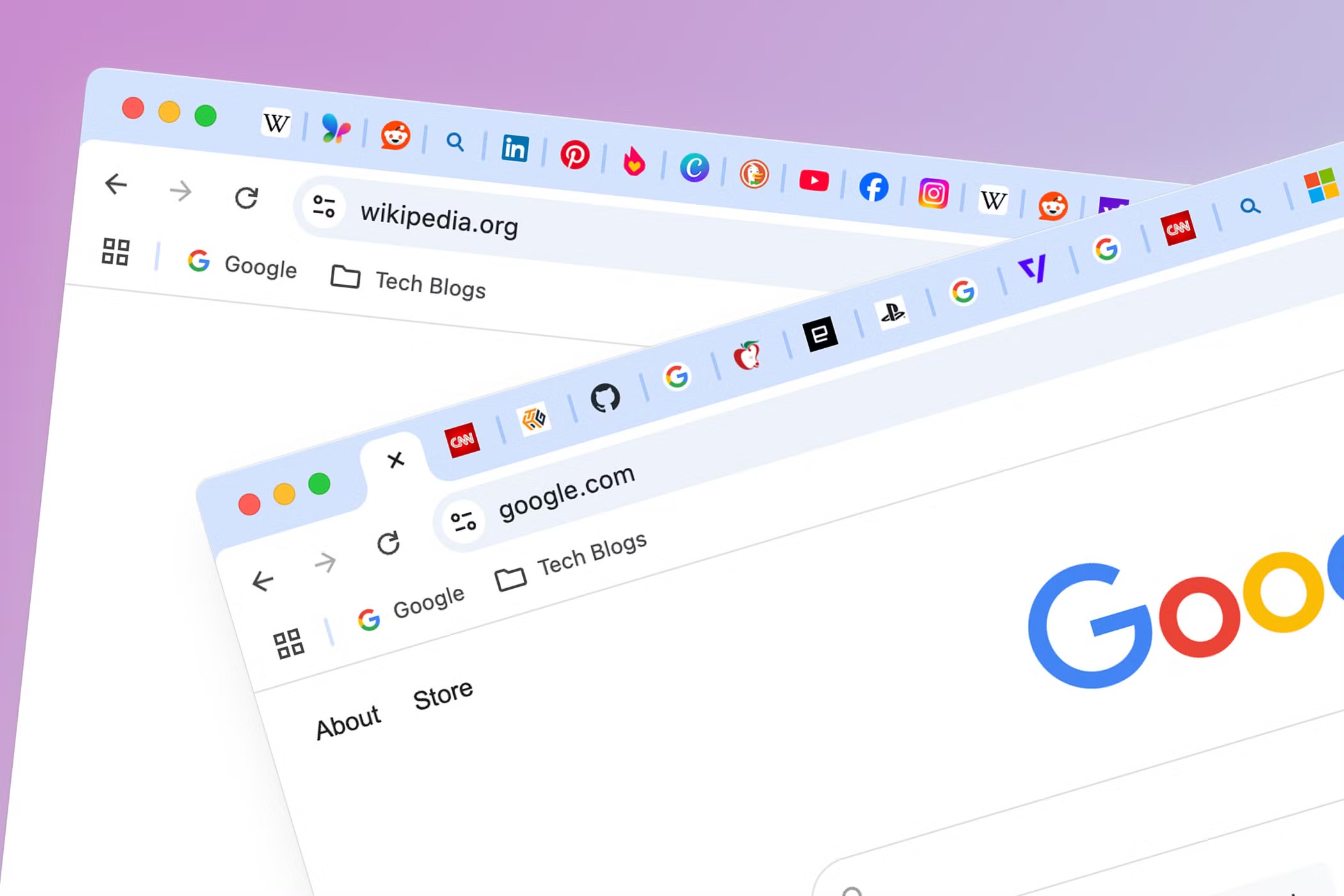

I have 37 tabs open in my browser.
I know because I counted them once, although I immediately forgot the number and had to count again. There is a tab about a book I wanted to read, a video explaining a subject I have absolutely no reason to understand, three different articles about the same topic, a recipe I will probably never make and a page I opened so long ago that I can no longer remember what I was looking for.
Somewhere in there is also a Google search for something I urgently needed to know at 11:43 p.m. on a Tuesday. I have no idea what it was. Apparently, it was important enough to deserve its own tab, but not important enough for me to remember.
Every few days, I make a promise to clean everything up. I move my cursor toward the little X in the corner of a tab, hesitate, and think, “Wait. I might need that.” And so it stays.
The tab becomes smaller. Its title disappears. Eventually, all that remains is a tiny, mysterious icon. I no longer know what it contains, but closing it feels strangely irresponsible. What if I need it tomorrow? What if that article contains the one piece of information that will change my life?
I have, in other words, developed an emotional attachment to rectangles. Apparently, I am not alone.
In a 2021 study of browser tab overload, researchers at Carnegie Mellon University examined why people struggle to manage browser tabs. They found that people often keep tabs open as reminders or because they worry they will never find the information again. Some users even felt invested in their open tabs, making them reluctant to close them despite feeling overwhelmed.
The researchers described a strange contradiction: we keep tabs open because we are afraid of losing something, then become overwhelmed by the very things we refuse to lose. It sounds ridiculous until you realize how familiar it is.
We do this with more than browser tabs. We save videos we never watch, bookmark articles we never read, screenshot places we never visit and add songs to playlists that eventually become digital museums of our past interests. We collect information as if collecting it were the same as experiencing it.
Somewhere along the way, “I want to learn about this” became “I should save this for later.” This later became a place where things go to disappear.
There is a psychological reason unfinished things can be difficult to leave behind. In a 2009 study published in Organizational Behavior and Human Decision Processes, psychologist Sophie Leroy examined what happens when people switch from one task to another. She described a phenomenon called attention residue: even after we move on to a new task, part of our attention can remain attached to the previous one, particularly when it is unfinished. That lingering attention can make it harder to concentrate on what comes next.
A browser full of unfinished reading is not exactly the same as the work tasks in Leroy’s experiments. But the idea offers a useful way to understand why our minds sometimes feel crowded by things we have not completed. A page we intend to read, a project we mean to start or an idea we keep postponing can continue occupying a small corner of our attention.
And perhaps that is why closing a tab can feel more significant than it should. It is not always the information we are afraid of losing. Sometimes, it is the possibility attached to it.
Consider the tabs themselves. One represents the language I promised myself I would learn. Another contains a university course I imagined taking someday. There is a guide to photography, a list of books recommended by someone I admire, and an article about a career I might pursue if I ever decided to completely change my life.
Each tab belongs to a slightly different version of me. There is the version who wakes up early and reads the news, the version who learns a new instrument and the version who finally understands economics. Then the version who travels somewhere unfamiliar, starts a creative project and somehow manages to finish everything she begins.
They are all waiting patiently in the browser, like tiny, unopened doors.
The internet makes it remarkably easy to imagine becoming someone. With a single search, we can find the books that person reads, the skills they learn, the places they visit and the routines they follow. We can save all of it in seconds. We can build an impressive collection of possible futures without having to commit to any of them.
The problem is that saving something feels like progress. It gives us the pleasant sensation of having taken a step toward a goal, even when all we have really done is open another tab.
A 2025 meta-analysis of the Zeigarnik and Ovsiankina effects, published in Humanities and Social Sciences Communications, revisited two well-known psychological effects associated with interrupted tasks. Its researchers found that unfinished tasks did not consistently improve memory, as the popular version of the Zeigarnik effect suggests. However, they did find a general tendency for people to resume interrupted tasks.
In other words, the pull of unfinished things is more complicated than the familiar claim that we simply remember everything we leave incomplete.
That distinction matters. Not every open tab is secretly haunting us, and not every abandoned interest represents a meaningful personal failure. Sometimes a page is just a page. Sometimes we open something out of curiosity and lose interest five minutes later.
We are allowed to change our minds. But perhaps the more interesting question is why we feel the need to keep so many possibilities within reach.
We live in a time when almost anything can be learned, watched, read or explored with a few clicks. This abundance is wonderful. It also creates the strange impression that we should be interested in everything. Every recommendation suggests another book we should read, another skill we should develop or another experience we should have before we run out of time.
Even our curiosity can start to feel like homework.
Maybe that is what my 37 tabs are really telling me. Not that I am particularly disorganized, although that is certainly part of it, but that I am reluctant to choose. Closing a tab means admitting that I might not read that article, learn that language or become that particular version of myself. Keeping it open allows me to postpone the decision.
The little X in the corner is not just a button. It is a tiny commitment to let something go.
There is something freeing about recognizing that we cannot become every possible version of ourselves. Curiosity is not measured by the number of things we save. It is also measured by the things we actually give our attention to.
So perhaps I should close a few tabs, not because productivity experts say I should or because an empty browser is somehow a sign of a better-organized life. But because I would rather spend an hour reading one interesting article than spend that hour collecting 30 more.
I might never make that recipe. I might never need that obscure historical fact or become the person who wakes up at 5 a.m. to read the news. That is okay.
There are still plenty of things worth discovering. There are simply not enough hours to keep every possibility open. As for the 37 tabs? I am still working on it.
Actually, I just opened another one.


